
leave a message
If you are interested in our products and want to know more details,please leave a message here,we will reply you as soon as we can.


Two continents. One design team. Twelve time zones apart, Mike __ an industrial designer based in the United States __ and our engineering team in Xiamen spent [1 months] turning a rough idea into a product you can trust on a bumpy trail.
This is the story of how that product was designed: not a marketing story, but a manufacturing story. Because at Yistar Plastic, we believe the quality of a product is decided long before the first part comes out of the mold __ it is decided in the design
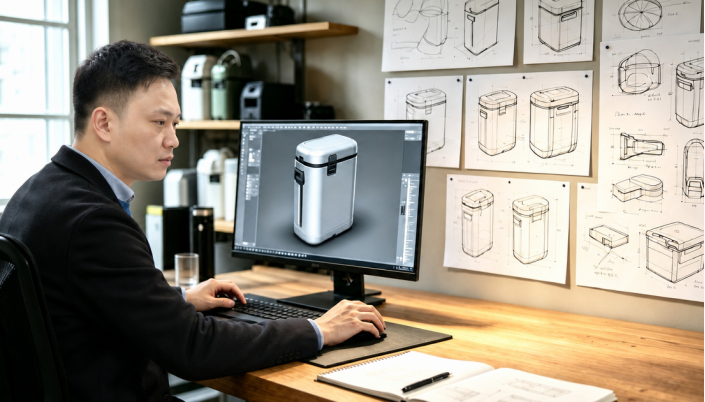
Stage 1 __ Discovery: Listening Before Drawing
Good product design never starts with a sketch. It starts with a problem.
Mike came to us with deep field research from the outdoor community. Overlanding and camping enthusiasts were frustrated with gear storage that:
 Dented and deformed after years of bouncing around in a truck bed;
 Had latches that cracked in cold weather;
 No reliable anchor points for straps and tie-downs;
 Looked worn out after a single season in the sun.
Our fi rst workshop converted those user frustrations into an engineering requirements list: impact resistance, weather sealing, UV stability, secure lashing points, and a form factor that fits a vehicle bed without wasting space. Every requirement was
written down and agreed before a single line was drawn __ this document became the contract between designer and manufacturer for the rest of the project.
Stage 2 __ Concept & Sketching
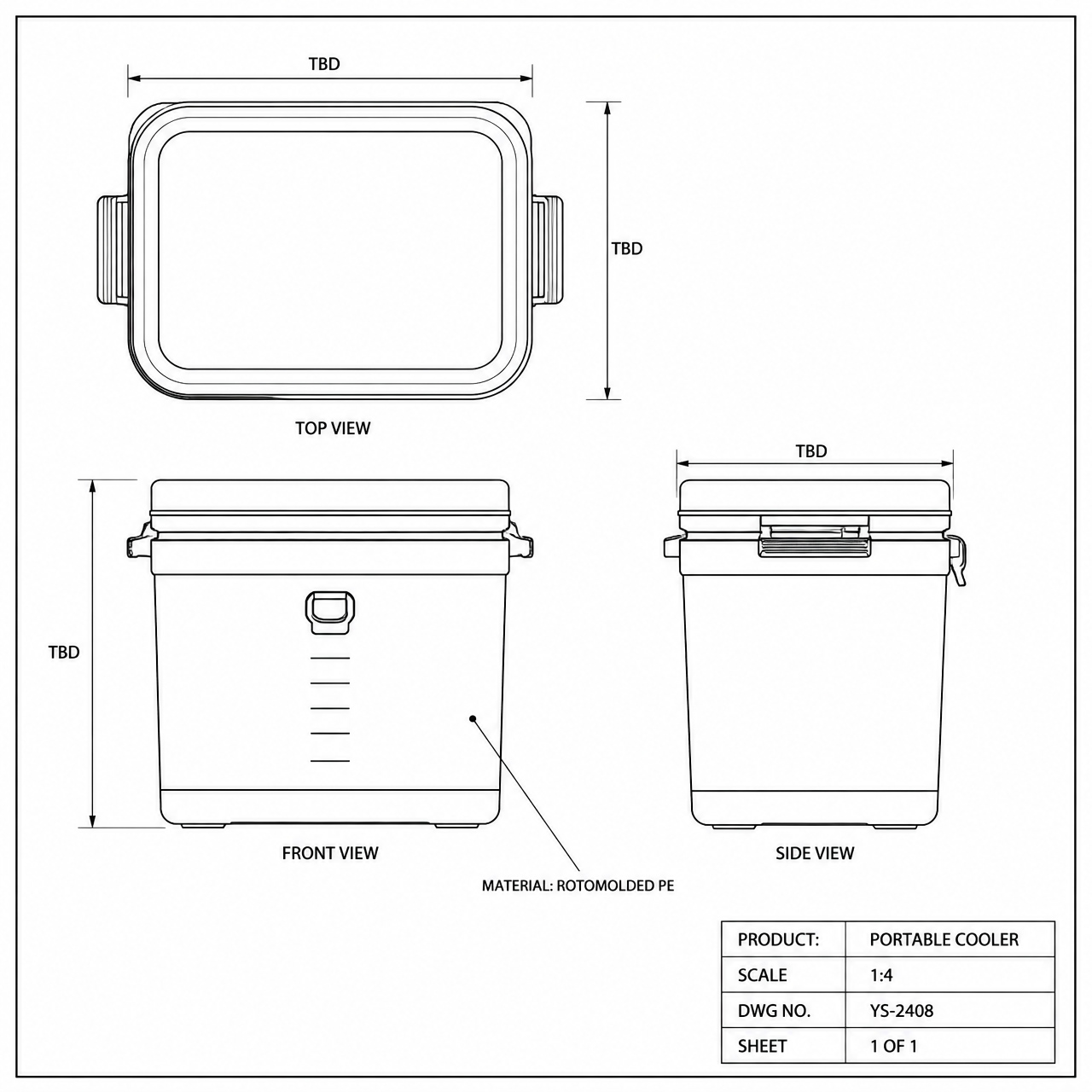
With the requirements locked, Mike developed the fi rst concepts on paper: a tall, rounded rectangular body with a recessed, gasketed lid; large latches that a gloved hand can operate; and a reinforced base that survives being dragged across gravel.
Early sketches tested proportions and ergonomics __ where the handle sits, how the latches feel, how the cooler looks on a tailgate. At this stage we also agreed on a non-negotiable principle: the design must be honest to the process that will make it. A shape that looks great in a sketch but cannot be molded reliably is not a design __ it is a problem waiting to happen.
Stage 3 __ Design for Manufacturing (DFM): The Bridge Between Ideas and Molds
This is where an OEM partner earns its keep.
We reviewed Mike's concepts through the lens of rotational molding (rotomolding) __ the process we selected for this product because it produces large, hollow, impact-resistant parts with excellent wall strength and a lower tooling investment than
injection molding at this size.
Our DFM review covered:
 Uniform wall thickness __ rotomolding builds walls by fusing resin powder to a heated mold surface; sharp corners and thin sections are the enemy of consistent thickness.
 Draft angles and corner radii __ every vertical wall and internal corner was adjusted so the part releases cleanly from the mold.
 Wall-to-feature transitions __ ribs, latch bosses, and handle attachment points were redesigned so that thick and thin sections fiow smoothly, avoiding stress concentrations.
 Mold complexity vs. cost __ we simplified features that would have required expensive mold action, cutting tooling cost without sacrificing function.
Stage 4 __ 3D CAD & Structural Engineering
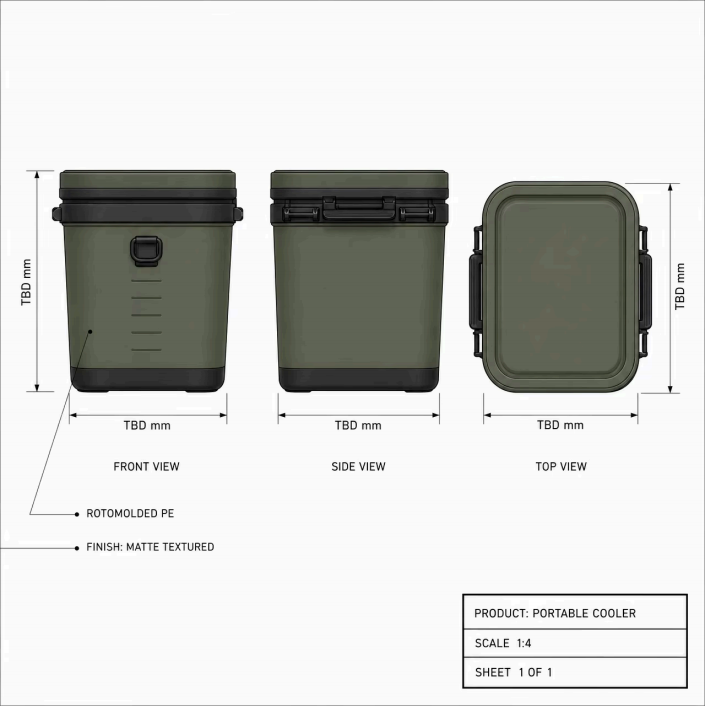
With the DFM rules agreed, our engineers built the full 3D model. This stage turned the concept into geometry that can be measured, analyzed, and molded:
 Tie-down slots __ the vertical lashing points on the body were engineered with reinforced ribs so straps can be cinched hard without deforming the wall.
 Gasketed lid __ the recessed lid and seal groove were designed for consistent compression, keeping dust and moisture out on the trail.
 Latch and handle bosses __ the mounting areas were thickened and ribbed to survive repeated loading and cold-weather impact.
 Base plate __ a black, abrasion-resistant base was designed to take the worst of the abuse while keeping the main body intact.
Every load-bearing feature was reviewed with the prototype in mind: design intent on screen, manufacturing reality in the shop.
Stage 5 __ Material Selection
The material decision is a design decision. We selected a rotational-molding-grade polyethylene __ the workhorse of heavy- duty outdoor products __ because of its toughness, low-temperature impact performance, and UV resistance.
For this project the material specification included:
 UV stabilization __ so the olive-green<span styl
leave a message
Scan to Wechat :

Scan to WhatsApp :