
leave a message
If you are interested in our products and want to know more details,please leave a message here,we will reply you as soon as we can.


When your product needs the grip of a soft-touch handle bonded to a rigid structural core — overmolding is the answer. This guide breaks down the two dominant approaches, material pairing rules, and when each method delivers the best ROI for your project.
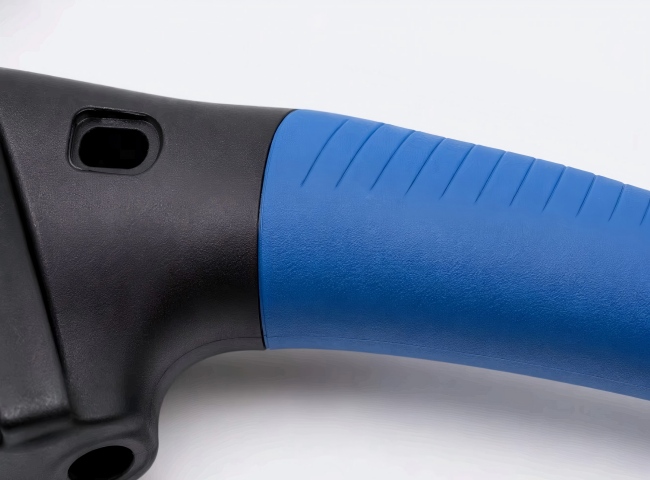
Overmolding is an injection molding process where two or more materials are combined into a single, integrated part. Typically, a rigid thermoplastic substrate is molded first, then a second material — often a soft elastomer like TPE or TPU — is molded over or around it. The result: a single component with the mechanical strength of hard plastic and the tactile comfort of rubber.
This process eliminates secondary assembly steps like gluing, snapping, or screwing components together. The chemical or mechanical bond formed during molding is often stronger and more durable than any post-assembly method.
The industry distinguishes between two core overmolding approaches. Understanding the difference is critical for cost estimation and design feasibility.
|
Factor |
Two-Shot (2K) Molding |
Insert Overmolding |
|
Process |
Both materials injected in a single machine cycle with a rotating mold |
Substrate molded first, then manually or robotically placed into a second mold |
|
Cycle Time |
Faster — single machine, continuous operation |
Slower — two separate molding cycles plus handling |
|
Bond Strength |
Excellent chemical bond (materials join while still hot) |
Good mechanical or chemical bond, but substrate cools between steps |
|
Tooling Cost |
Higher upfront (complex rotating mold) |
Lower upfront (two simpler molds) |
|
Labor Cost |
Lower (fully automated) |
Higher (manual or semi-automated insert loading) |
|
Best For |
High-volume production (100,000+ units) |
Low-to-medium volumes, prototyping, multi-cavity flexibility |
|
Material Flexibility |
Limited to chemically compatible pairs |
Broader compatibility — mechanical interlocks can compensate |
The decision boils down to volume. If you're producing under 50,000 units annually, insert overmolding with a trusted partner like Yistar Plastic typically delivers better unit economics. Above 100,000 units, two-shot molding's cycle-time advantage and reduced labor make it the clear winner.
Not all plastics bond to each other. The success of an overmolded part depends on selecting chemically compatible substrate-overmold pairs.
|
Substrate (Rigid) |
Overmold (Soft) |
Bond Type |
Typical Applications |
|
ABS |
TPE, TPU |
Chemical |
Power tool grips, toothbrush handles, consumer electronics |
|
PC |
TPE, TPU |
Chemical |
Medical device housings, protective cases |
|
PC/ABS |
TPE, TPU |
Chemical |
Automotive interior components, enclosures |
|
PP |
TPE (PP-based) |
Chemical |
Food containers with soft seals, bottle caps |
|
PA (Nylon) |
TPE, TPU |
Mechanical + Chemical |
Industrial tools, sports equipment |
|
PBT |
TPE |
Chemical |
Electrical connectors, sensor housings |
PE + TPE (non-PE-based)
● : Polyethylene's low surface energy prevents chemical bonding. Mechanical interlocks are essential.
POM (Acetal) + most TPEs
● : Acetal's naturally slippery surface resists adhesion. Special surface treatments are required.
PA + TPE (unconditioned)
● : Nylon absorbs moisture, which can interfere with bond strength if not properly dried before overmolding.
Pro tip from Yistar's engineering team: Always request a material compatibility test during the DFM (Design for Manufacturability) phase. A 48-hour trial with your exact material grade can prevent months of tooling rework.
Overmolding adds complexity to part design. These rules ensure first-shot success.
The substrate wall thickness should be as uniform as possible. Sudden thickness transitions create sink marks, warpage, and uneven cooling that can distort the overmold layer. Target a nominal wall of 2.0–3.0 mm for most engineering applications.
Even with chemically compatible materials, incorporate mechanical interlocks — grooves, undercuts, holes — wherever possible. A T-shaped groove in the substrate gives the overmolded material a physical anchor. This is especially critical for PP and PE substrates where chemical bonding is weaker.
The overmold gate should be positioned away from cosmetic surfaces. Gate vestige on a soft-touch grip is visually unforgiving. Submarine (tunnel) gates or valve gates that auto-shear during ejection produce the cleanest results.
Overmolded parts require draft on both substrate and overmold features. Standard draft is 1°–3° per side. For textured surfaces, add 1° of draft per 0.025 mm of texture depth.
Different materials shrink at different rates. TPE can shrink 1.5–3% while PC shrinks only 0.5–0.7%. If the substrate shrinks less than the overmold, the soft layer may crack or delaminate. Yistar's mold flow analysis software simulates shrinkage mismatch before steel is cut.
Overmolding isn't just for toothbrush handles. Here's where the technology delivers real competitive advantage:
Medical Devices: Ergonomic surgical instrument grips, sealed connectors for monitoring equipment, and overmolded seals on disposable devices. The seamless bond eliminates crevices where bacteria can collect.
Automotive: Interior switch panels with soft-touch buttons, weather-sealed connectors, anti-vibration mounts. Overmolding reduces part count — a single overmolded dash component can replace an assembly of 4–5 separate parts.
Consumer Electronics: Waterproof USB ports, shock-absorbing phone cases, soft-touch remote controls. Apple's AirPods case and many premium headphones rely on precision overmolding.
Industrial Tools: Hammer grips, power tool housings, anti-slip handles. The chemical bond withstands vibration, oil, and temperature cycling better than glued assemblies.
Household Products: Kitchen utensils with soft handles, container lids with integrated seals, baby bottle components that need both rigidity and soft touch.
|
Cost Factor |
Without Overmolding |
With Insert Overmolding |
With 2K Molding |
|
Tooling |
|
|
|
|
Part Cost (per unit) |
|
$0.95 (integrated) |
$0.75 (integrated) |
|
Labor per 10,000 units |
~20 hours (assembly) |
~8 hours (insert loading) |
~0 hours (fully automated) |
|
Scrap Rate |
4–5% (assembly defects) |
2–3% (molding only) |
1–2% (continuous process) |
|
Time to Market |
Fast (simple tooling) |
Moderate (two mold builds) |
Slowest (complex mold design) |
For a project producing 200,000 units, switching from glued assembly to two-shot molding can reduce total part cost by 25–30% while improving quality. Yistar's engineering team provides a detailed cost comparison as part of every DFM report.
At Yistar Plastic, overmolding is a core competency, not an afterthought. Our Xiamen facility runs 20+ injection molding machines ranging from 90T to 650T, with dedicated two-shot capability on select presses. We've delivered overmolded components for medical, automotive, consumer electronics, and industrial clients across North America, Europe, and Southeast Asia.
What sets us apart:
● In-house mold design and fabrication — no outsourcing delays
● Material compatibility testing as a standard DFM deliverable
leave a message
Scan to Wechat :

Scan to WhatsApp :