
leave a message
If you are interested in our products and want to know more details,please leave a message here,we will reply you as soon as we can.


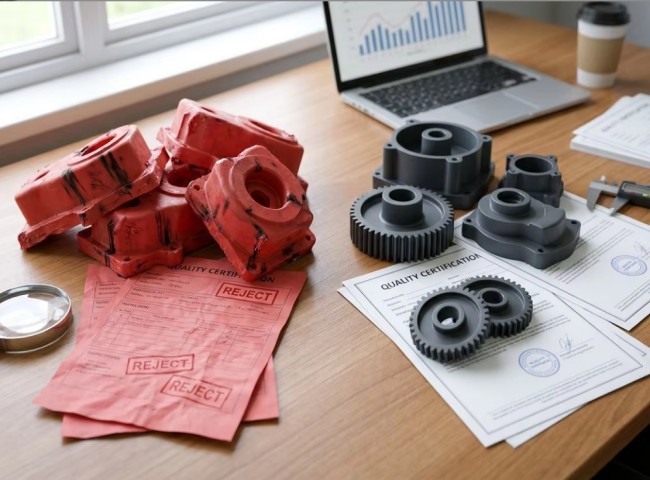
Most companies stay with underperforming injection molding suppliers far too long. Not because they're satisfied — but because switching feels risky. Will the new supplier actually be better? Will the transition disrupt production? Will quality problems just follow you to the next vendor?
The reality: staying with the wrong supplier is usually more expensive than switching. Every defective batch, every missed deadline, every communication breakdown chips away at your margins, your reputation, and your sanity. Here are the seven clearest signals that it's time to make a change — and what the alternative looks like.
The red flag: Quality was solid for the first few orders. Then you noticed cosmetic defects. Then dimensional issues started showing up in small batches. Now QC rejects are routine, and your team treats incoming inspection as damage control rather than a formality.
What's actually happening: In injection molding, quality degradation is almost never random. It's a symptom of:
● Deferred mold maintenance — cavities wear, ejector pins loosen, cooling channels clog
● Material substitution — your supplier switched to a cheaper resin without telling you
● Process drift — injection parameters adjusted to speed up cycle times at the expense of part quality
● Cavity neglect — 8-cavity mold, but cavities 5 and 6 are producing out-of-spec parts and nobody's monitoring individual cavity performance
What a good supplier does differently: Documented preventative maintenance schedules per mold, cavity-by-cavity weight monitoring, and a process parameter lock system that requires engineering approval for any adjustment. At Yistar, we track Cp/Cpk (process capability) data for critical dimensions on every production run. You see the trend before it becomes a problem.
The red flag: The first order took 4 weeks. The second took 5. Now your supplier quotes 6-8 weeks but delivers in 10. Every conversation about timing involves apologies and excuses rather than solutions.
What's actually happening: Your parts are almost certainly not your supplier's top priority. Either they're overbooked and slotting your orders into whatever capacity is left, or they're prioritizing higher-margin customers and fitting you into the gaps. Neither situation gets better on its own.
What a good supplier does differently: Capacity planning that accounts for existing customer commitments before accepting new orders. Transparent production scheduling that tells you upfront when your mold will run. At Yistar, we maintain a minimum 15% buffer capacity to absorb urgent orders without disrupting scheduled production. If we quote 4 weeks, the mold runs in week 2 and parts ship in week 4.
The red flag: Your incoming inspection team finds issues that your supplier's outgoing inspection should have caught. You're investing in measurement equipment and inspection labor that should be on the supplier's side of the relationship. When you raise an issue, the response is "oh, we'll check more carefully next time" — which never actually translates to systematic improvement.
What's actually happening: Your supplier treats quality control as a cost center rather than a value driver. They're doing minimal inspection to keep costs down, gambling that you won't notice or won't care enough to switch.
What a good supplier does differently: A documented quality system that catches defects before they leave the factory. At Yistar, our 12-point QC process (documented in our factory transparency article) covers everything from incoming material verification to AQL-based final sampling inspection. You receive inspection reports with your shipment, not excuses after it.
Real client example: A medical device manufacturer came to us after their previous supplier shipped three consecutive batches where 8-12% of parts failed their in-house QC. After transitioning to Yistar, their incoming inspection rejection rate dropped to under 0.3% within two months. Their QC team went from damage control to verification — and reclaimed 15 hours of inspection labor per week.
The red flag: You send an email on Monday. You send a follow-up on Wednesday. You get a one-line response on Friday that doesn't actually answer your question. Phone calls go to voicemail. When there's a problem, you hear about it after it's too late to fix. Your main contact seems to change every few months.
What's actually happening: Your account isn't important enough for your supplier to invest in relationship management. Or their internal communication is so disorganized that your project status is genuinely unknown to anyone you can reach.
What a good supplier does differently: A dedicated account manager who knows your project history, your mold status, your upcoming orders, and your specific quality requirements. Regular check-ins that aren't sales calls. Proactive communication when something changes — before you have to ask. At Yistar, we assign every client a project engineer who speaks fluent English and has direct access to the production floor. You get answers in hours, not days.
The red flag: Your first order was simple — single-material, single-cavity, straightforward geometry. Your supplier handled it fine. But now your product has evolved: overmolding, insert molding, tighter tolerances, secondary operations. Your supplier keeps saying "yes, we can do that" — but the results say otherwise.
What's actually happening: Your supplier's capability ceiling is lower than your product's trajectory. They're taking on work they can't execute, hoping they'll figure it out along the way. You're paying for their learning curve with your product quality and launch timeline.
What a good supplier does differently: Honest capability assessment upfront. If we can't execute a specific process to your specifications, we'll tell you — and connect you with a partner who can, or invest in the capability if the volume justifies it. At Yistar, our capabilities span single-shot molding, 2K overmolding, insert molding, ultrasonic welding, pad printing, and assembly — so your product complexity can grow without outgrowing your supplier.
The red flag: You've never signed an NDA, or the one you signed feels toothless. You've heard rumors about your supplier running "extra shifts" that produce parts for other customers using your molds. Your intellectual property — mold designs, material specifications, proprietary geometries — feels more like a shared resource than protected property.
What's actually happening: Intellectual property protection in international manufacturing is a trust-and-verification problem. Without contractual safeguards and operational controls, your IP is at risk. And once your mold design or product geometry is out there, there's no taking it back.
What a good supplier does differently: Comprehensive NDAs with enforceable terms, mold ownership clauses that clearly establish the mold as your property, and operational practices that segregate customer tooling. At Yistar, all customer molds are stored in a secured, access-controlled tooling area. We sign NDAs as standard practice before receiving any CAD files or technical specifications. And we've never had an IP dispute in our operating history — because we don't create them.
The red flag: When you ask about quality systems, they talk about price. When you ask about lead times, they talk about price. When you ask about process control, they talk about price. Their entire value proposition is "we're cheaper" — and you're starting to understand why.
What's actually happening: Price-only suppliers compete on cost reduction, not value creation. They'll cut corners wherever possible — material quality, mold maintenance, inspection labor, operator training — to maintain their margin. Your product is absorbing the cost of those cuts.
What a good supplier does differently: Price matters. But so does quality, delivery reliability, communication, and engineering support. The right supplier offers competitive pricing as part of a broader value proposition — not as a substitute for everything else. At Yistar, our clients consistently tell us that our total cost of ownership is lower than cheaper suppliers, because they spend less on incoming inspection, rework, expedited freight, and firefighting.
Let's quantify what a bad supplier actually costs you. These are real numbers from real client transitions:
|
Hidden Cost |
Annual Impact (Estimate) |
|
Additional incoming inspection labor |
|
|
Rework and scrap from defective batches |
|
|
Expedited freight to recover from late deliveries |
|
|
Lost sales from stockouts |
|
|
Management time spent on supplier issues (at loaded labor rate) |
|
|
Brand reputation damage from customer quality complaints |
Unquantifiable |
Total potential annual drain:  245,000+
Against that, the cost of switching suppliers — qualification samples, tooling transfer, initial ramp-up support — typically runs  15,000. The ROI of switching is measured in weeks, not years.
If you're seeing multiple signs above, here's the transition roadmap we recommend:
Phase 1 — Qualification (Weeks 1-3):
● Send your new supplier CAD files and specifications
● Request a DFM (Design for Manufacturability) analysis
● Review sample parts from similar projects
● Verify certifications (ISO, material-specific, industry-specific)
● Conduct a virtual or in-person factory audit
Phase 2 — Sampling (Weeks 4-6):
● New supplier produces a pilot run of 50-200 parts
● You inspect dimensional accuracy, surface finish, and functional performance
● If issues arise, supplier adjusts process parameters
● Re-sample until parts meet specification
Phase 3 — Dual-Source Transition (Weeks 6-10):
● Place a partial order with the new supplier while maintaining your existing supply
● Compare incoming quality data between suppliers
● Once the new supplier proves consistency, increase their order volume
Phase 4 — Full Transition (Weeks 10-14):
● Reduce and eventually phase out orders with the old supplier
● Transfer or retrieve your molds (ensure you have legal ownership documentation)
● Establish ongoing quality monitoring and communication cadence with the new partner
The key: don't burn the bridge behind you until the road ahead is proven. A controlled dual-source transition protects your supply chain while you validate the new relationship.
When evaluating potential new suppliers, prioritize these four attributes over price:
Process transparency:
1. Can they show you how they control quality, not just tell you about it?
Engineering capability:
2. Do they offer DFM feedback that improves your design, or do they just quote what you send?
Communication responsiveness:
3. Do they answer specific technical questions with specific technical answers?
Cultural alignment:
4. Do they treat quality, IP protection, and deadlines the same way you do?
Switching injection molding suppliers is a decision, not a crisis. Every day you stay with a supplier who's underperforming in quality, delivery, or communication is a day your competitors are getting ahead.
At Yistar Plastic, we earn our clients' business by solving the problems their previous suppliers created. If you're seeing two or more of the signs above, let's talk. We'll audit your current parts, identify the root causes of your quality issues, and build a transition plan that keeps your production running while we raise the standard.
No pressure. No pitch. Just an honest assessment of whether we're the right fit for what you need next.
Keywords: switch injection molding supplier, plastic parts quality issues, China injection molding supplier assessment, manufacturing supplier transition, injection molding quality problems, find reliable plastic manufacturer, injection molding supplier evaluation checklist
leave a message
Scan to Wechat :

Scan to WhatsApp :