
leave a message
If you are interested in our products and want to know more details,please leave a message here,we will reply you as soon as we can.


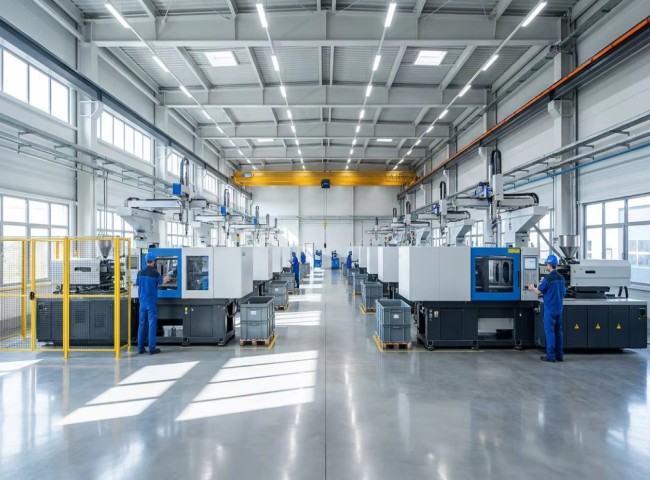
When you trust a supplier with your injection molding project, you're not just buying parts. You're buying capacity, consistency, and the peace of mind that your supply chain won't fall apart at the worst possible moment. At Yistar Plastic, we believe the best way to earn that trust is to show you exactly how we work. No stock photos. No vague promises. Just the real factory floor and the processes that keep quality consistent across millions of parts.
Our 5,000-square-meter manufacturing facility in Xiamen houses 18 injection molding machines ranging from 50 to 800 tons of clamping force. That range matters — it means we can mold everything from tiny electronic connector housings weighing under a gram to large automotive components exceeding 2 kilograms.
What this means for your project: You don't have to switch suppliers when your product line expands. The same team, the same quality system, the same accountability — whether you need 50-ton or 500-ton capacity.
Every machine on our floor is equipped with servo-driven hydraulic systems, reducing energy consumption by up to 60% compared to conventional hydraulics. More importantly, servo control delivers tighter shot-to-shot consistency — the difference between parts that "mostly fit" and parts that fit every single time.
|
Tonnage Range |
Quantity |
Typical Applications |
|
50T - 120T |
8 machines |
Small precision parts, electronic connectors, medical device components |
|
150T - 300T |
6 machines |
Medium enclosures, appliance housings, consumer product shells |
|
400T - 800T |
4 machines |
Large structural parts, automotive components, industrial equipment housings |
Walk into our material preparation area and you'll find something most injection molding shops don't show you: a climate-controlled raw material storage room with dedicated drying stations for each resin type.
Why this matters: Hygroscopic materials like nylon (PA6, PA66), polycarbonate, and PET absorb moisture from the air. Inject moist material into a mold and you get splay marks, bubbles, and degraded mechanical properties. Our drying protocol ensures every pellet entering the hopper has moisture content below the manufacturer's specified maximum — typically under 0.02%.
We maintain an inventory of over 50 standard resin grades, from commodity materials like PP and ABS to engineering thermoplastics including:
PA66+GF30/GF50
● (glass-filled nylon for structural applications)
PC/ABS blends
● (impact resistance with aesthetic surface finish)
POM (Delrin)
● (high stiffness, low friction for gears and bearings)
TPE/TPU
● (thermoplastic elastomers for overmolding and soft-touch grips)
PEEK
● (high-temperature performance up to 260°C)
Medical-grade PP and PC
● (ISO 10993 biocompatible)
Every incoming material batch is logged with a certificate of analysis. Before production begins, our technicians run a melt flow index test to verify the resin's processing behavior hasn't changed — a critical step that catches batch variations before they become batch defects.
Our in-house tooling department is staffed by mold makers with an average of 12 years of experience. We design and fabricate injection molds using:
CAD/CAM software:
● SolidWorks and Mastercam for mold design and CNC programming
CNC machining centers:
● High-speed 3-axis and 5-axis machines for cavity and core machining, achieving tolerances of ±0.01 mm
EDM (Electrical Discharge Machining):
● Sinker and wire EDM for complex geometries and sharp internal corners that cutting tools can't reach
Surface grinding and polishing:
● Achieving SPI finish grades from A-1 (diamond-buffed mirror) to D-3 (coarse blasted matte)
Every mold undergoes a first-article inspection (FAI) before entering production. We measure every critical dimension on the first shot parts, compare against the customer's 2D drawing or 3D model, and document the results. You receive the inspection report before we ship a single production part.
Mold life expectancy: Our standard production molds are rated for 500,000 to 1,000,000 shots. With our preventative maintenance program — which includes regular cleaning, lubrication, and wear inspection — many exceed 1.5 million cycles before requiring major refurbishment.
Quality at Yistar isn't a final inspection step. It's embedded throughout the entire production process. Here's the system that keeps defect rates below 0.5%:
|
Step |
Checkpoint |
What We're Looking For |
|
1 |
Incoming material verification |
Certificate of analysis, melt flow index, moisture content |
|
2 |
Mold setup approval |
Cleanliness, proper installation, cooling circuit function |
|
3 |
First-shot approval |
Dimensional verification against CAD, visual inspection, weight check |
|
4 |
Process parameter lock |
Injection pressure, hold time, cooling time, melt temperature documented |
|
5 |
In-process inspection (every 2 hours) |
Critical dimensions, visual defects, color consistency |
|
6 |
Cavity balancing check |
Part weight from each cavity — any deviation triggers investigation |
|
7 |
Shift handover protocol |
Outgoing shift documents all adjustments; incoming shift verifies before resuming |
|
8 |
Post-molding handling |
Parts inspected as they exit the mold; gates trimmed to specification |
|
9 |
Secondary operations QC |
Ultrasonic welding, pad printing, heat staking — each verified independently |
|
10 |
Assembly verification |
If we assemble your product, every unit is functionally tested |
|
11 |
Final inspection (AQL sampling) |
Per ISO 2859-1, typically AQL 1.0 for critical defects, 2.5 for major |
|
12 |
Packaging and shipment check |
Quantity verification, packaging integrity, labeling accuracy |
Our quality lab is equipped with:
CMM (Coordinate Measuring Machine):
● Automated 3D measurement with ±0.002 mm accuracy. We can measure complex geometries and generate deviation reports against your CAD model.
Vision Measurement System:
● Optical measurement for small features, radii, and angles — faster than CMM for 2D dimensions.
Digital Height Gauge and Micrometers:
● Daily-use precision tools calibrated on a documented schedule.
Color Spectrophotometer:
● Ensures color consistency across production batches, critical for consumer-facing parts.
Universal Testing Machine:
● Tensile strength, flexural modulus, and impact resistance testing to verify mechanical properties.
The Situation: A European startup developing a medical diagnostic device came to us with a problem. Their previous supplier had delivered 5,000 enclosures with inconsistent snap-fit dimensions — some too tight to assemble, some too loose to stay closed. They were 4 weeks from their product launch.
What We Did:
Day 1-2:
1. Received their CAD files and existing mold. Performed a full mold inspection and identified worn slide mechanisms causing dimensional drift.
Day 3-7:
2. Refurbished the mold slides, polished cavity surfaces, and ran a 50-shot trial. Measured all critical snap-fit dimensions on every 10th part. All within ±0.05 mm tolerance.
Day 8-14:
3. Ramped to full production. Ran 24-hour shifts with our 12-point QC system. Shipped 5,000 verified parts by Day 14.
The Result: The client launched on time. They've since ordered 8 additional molds through us and consolidated their entire plastic supply chain under Yistar.
Client's words: "We went from considering delaying our launch to shipping on schedule. Your team didn't just fix the mold — you gave us confidence that our supply chain was finally in good hands."
We don't treat sustainability as a marketing slogan. Our operational practices include:
Closed-loop cooling water systems
● that reduce water consumption by over 80% compared to once-through cooling
Regrind management:
● In-process sprues and runners are reground and reintroduced at controlled ratios (typically up to 20% for non-critical applications), validated by mechanical testing
Energy monitoring:
● Real-time power consumption tracking on every machine, identifying optimization opportunities
Material waste reduction:
● Our mold design approach minimizes runner volume, and we work with clients to specify regrind-appropriate applications where possible
Before you place your next order, ask these five questions. If a supplier hesitates or deflects, take note.
"Can you share your process capability data (Cp/Cpk) for the tolerances my parts require?"
1.
"What is your mold maintenance schedule, and how do you track mold cycle counts?"
2.
"How do you handle a batch that fails final inspection — what's the corrective action process?"
leave a message
Scan to Wechat :

Scan to WhatsApp :