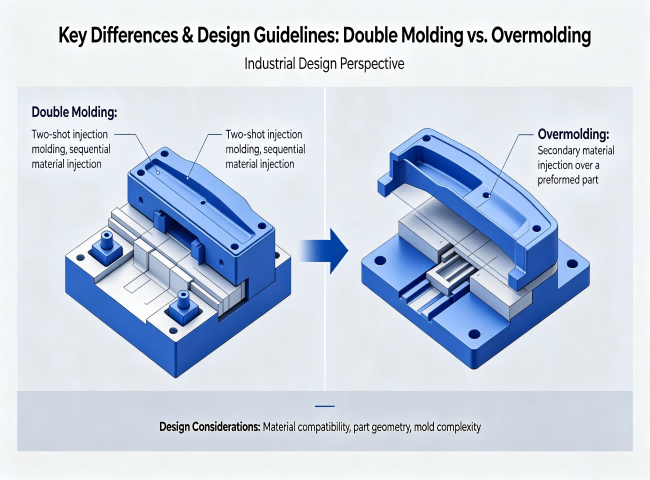
In the world of plastic injection molding, "Two-Shot Molding" and "Overmolding" are often confused. While both produce multi-material parts, their production workflows, equipment requirements, and costs vary significantly.
1. What is the Difference?
- Two-Shot Molding (Double Injection) This process involves two different materials injected into a single mold within one injection cycle. It requires a specialized two-color injection machine and a complex, high-precision mold. The product is ejected once as a finished piece.
- Overmolding (Secondary Molding) This is a two-step process. First, a substrate (the base part) is molded. It is then removed and placed into a second mold where a second material is molded over it. This uses standard injection machines but requires two separate mold sets.
2. Core Design Considerations for Two-Shot Molding
To ensure successful production, engineers must follow these critical design rules:
- Symmetry and Rotation: The two Cores must be identical, while the Cavities are different. The front and back halves of the mold must align perfectly after a 180-degree center rotation.
- Material Sequence: The "Hard-to-Soft" rule applies 99% of the time. Mold the rigid substrate first, followed by the flexible (soft) material, as soft materials deform easily under high pressure.
- Seal-off Precision: During the second injection, the cavity design must avoid scratching the first part. Precise seal-offs are essential to prevent flashes or leaks under high injection pressure.
- Bonding Strength: Material compatibility is key. For example, use specialized TPU for bonding. Interestingly, a smoother mold surface often results in a tighter chemical bond between materials.
- Machine Compatibility: Always verify the injection machine’s specifications, including maximum/minimum mold thickness and ejector pin hole spacing (minimum 210mm recommended).
3. Why Choose Which?
- Choose Two-Shot for high-volume, high-precision products where aesthetics and tight tolerances are critical (e.g., premium electronics, medical devices). It has a higher initial cost but lower unit labor costs.
- Choose Overmolding for lower volumes or when using machines you already have. It offers more flexibility but involves higher manual handling costs.
-