
leave a message
If you are interested in our products and want to know more details,please leave a message here,we will reply you as soon as we can.


Sustainability is no longer a buzzword in injection molding — it's a competitive advantage. Global buyers are increasingly factoring environmental performance into supplier selection. Here's how leading manufacturers are integrating recycled materials, reducing energy consumption, and meeting the demands of a carbon-conscious supply chain.

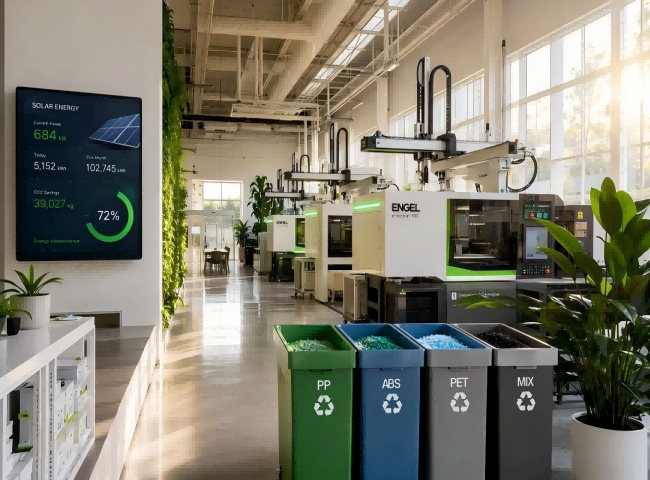
The Sustainability Imperative in Plastic Manufacturing
The numbers tell a stark story. The global plastics industry produces over 400 million metric tons annually, with packaging and consumer goods accounting for roughly 45% of that volume. Meanwhile, major brands — from IKEA to Adidas to Apple — have publicly committed to incorporating 25–50% recycled content into their plastic components by 2030.
For OEMs and product companies sourcing injection molded parts, this means one thing: your manufacturing partner's sustainability credentials directly impact your ability to win contracts.
The EU's Carbon Border Adjustment Mechanism (CBAM), expanding regulations in North America, and retailer sustainability scorecards are all pushing procurement teams to evaluate not just price and quality, but environmental footprint. A Chinese manufacturer with verifiable green practices is no longer a "nice to have" — it's a supply chain requirement.

Recycled Plastics in Injection Molding: What Actually Works
Not all recycled materials perform equally in high-precision injection molding. Understanding material grades and their limitations is essential for setting realistic expectations.
Post-Industrial Recycled (PIR) Materials
PIR materials come from factory scrap — sprues, runners, and rejected parts that never left the manufacturing facility. Because the material history is known and contamination risk is minimal, PIR resins can often replace virgin material at 20–50% blend
ratios with minimal performance impact.
Best PIR candidates for injection molding:
 rPP (Recycled Polypropylene): Ideal for containers, caps, automotive interior trim. Maintains >90% of virgin tensile strength at 30% blend.
 rABS: Suitable for electronic housings, appliance components. Slight color variation is the main trade-off.
 rHDPE: Excellent for industrial components, crates, piping fittings.
Post-Consumer Recycled (PCR) Materials
PCR materials come from end-user waste — water bottles, food containers, consumer packaging. They require rigorous sorting, washing, and reprocessing. Contamination risk and property degradation are higher than PIR.
What to expect with PCR:
 Mechanical properties typically degrade 10–20% per recycling cycle
 Color consistency requires masterbatch compensation
 Odor may be present (relevant for consumer-facing products)
 Requires supplier certification (e.g., GRS — Global Recycled Standard) Bio-Based and Biodegradable Resins
Emerging alternatives worth watching:
 PLA (Polylactic Acid): Derived from corn starch or sugarcane. Compostable under industrial conditions. Heat deflection temperature of only 50–60°C limits high-temperature applications.
 PHA (Polyhydroxyalkanoates): Biodegradable in marine environments. Currently 3–5x the cost of commodity resins.

 Bio-PE / Bio-PP: Chemically identical to fossil-based versions but derived from sugarcane ethanol. Drop-in replacement with identical processing parameters.
Yistar 's approach: We recommend starting with PIR blends for most projects. The material is traceable, cost-competitive (typicaly 10–15% cheaper than virgin), and meets GRS certification requirements. PCR is reserved for clients with explicit sustainability marketing claims that benefit from the "ocean-bound plastic " or "consumer-recycled " narrative.

Energy Efficiency: The Overlooked Sustainability Lever
Material choice gets the headlines, but energy consumption is where manufacturers can make an immediate, measurable impact.
All-Electric vs. Hydraulic Injection Molding Machines
|
Metric |
Hydraulic Machine |
All-Electric Machine |
|
Energy Consumption |
0.8–1.2 kWh/kg of material |
0.35–0.55 kWh/kg of material |
|
leave a message leave a message
If you are interested in our products and want to know more details,please leave a message here,we will reply you as soon as we can.
|