



Consumer Electronics Housings: Design, Finish & Assembly

Best purchase I’ve made this winter! The color and knitting are exquisite and it’s so comfy! Went from NYC to Miami without ever taking it off. Super cute!!
A consumer electronics housing carries four jobs at once: it holds the internal parts, protects them from drops and heat, presents the product's surface to the buyer, and gives the assembly line something it can close quickly and consistently. Most housing problems trace back to a design decision made for one of those jobs at the expense of another, usually a wall thinned for weight that then fails an impact test or a snap-fit that cracks on the first assembly.
This guide covers the plastics used for consumer electronics housings, wall and rib proportions, snap-fit and boss design, the finishes that avoid painting, the assembly methods available, and what each choice does to piece price.
Xiamen Yistar Precision Manufacturing Co., Ltd is a plastic manufacturer established in 1995 in Xiamen, Fujian, China, with tooling and injection molding in one facility. Housing programmes usually need tooling changes after the first cosmetic sample, so having the moulder and the toolmaker in the same engineering review shortens that loop.
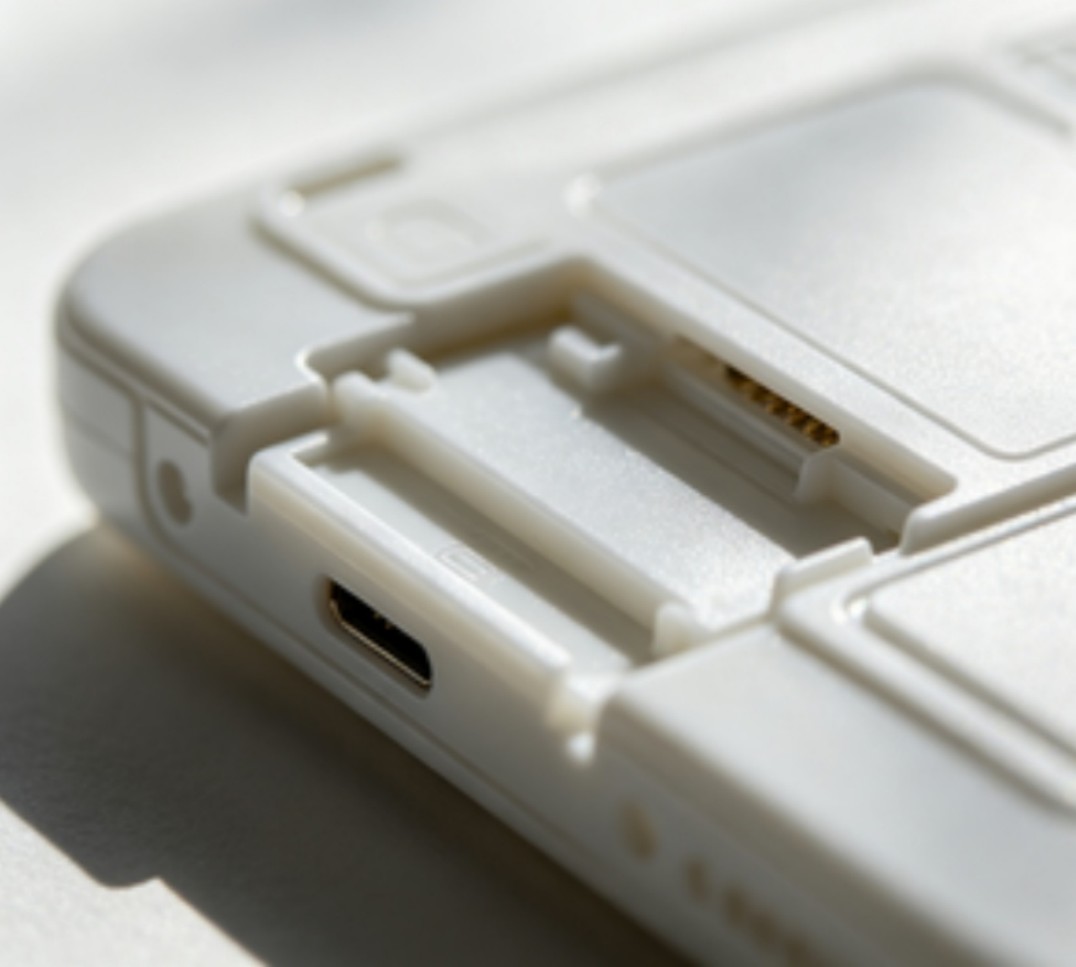
A kit such as the Modular DIY Electronics Enclosure Kit is moulded as a set of interlocking panels, so wall thickness, draft and joint design matter on every part in the set.
Key Takeaways
- ABS is the default cosmetic housing material at roughly 1.5 to 2.5 USD per kg, while PC and PC-ABS blends are specified where impact strength matters and cost 2.5 to 4.0 USD per kg.
- Wall thickness for handheld electronics housings normally sits between 1.5 mm and 3.0 mm, with ribs at 50% to 60% of the wall and bosses at 60% of the wall to avoid sink marks.
- Draft angle is 1° on smooth walls and 1.5° to 2° on textured walls, because texture depth consumes draft and causes drag marks on ejection.
- Textured moulds and in-mould decoration deliver a durable finish without painting, while pad printing and laser marking are used for small logos and functional legends.
- Ultrasonic welding with a 0.3 mm triangular energy director is the most common permanent enclosure joint, and needs a supporting wall behind the joint.
What Plastic Is Used for Consumer Electronics Housings?
Consumer electronics housings are normally moulded in ABS for cosmetics, PC or PC-ABS where impact strength is required, and glass-filled PA or PBT for internal structural parts. ABS gives the smoothest surface and the widest finishing options, while PC adds impact resistance and heat tolerance at a higher material cost.
The decision usually turns on three things: how the product is carried, how warm it gets inside, and what the surface must look like. A desktop device that rarely moves can be specified in plain ABS; a handheld or wearable product that will be dropped needs PC or a PC-ABS blend. A device with a warm power stage inside must be checked against the heat deflection temperature of the chosen grade, not against its room-temperature stiffness.
| Material | Notched impact strength | Heat deflection at 1.8 MPa | Material cost | Best fit |
|---|---|---|---|---|
| ABS | 200–350 J/m | 80–95 °C | 1.5–2.5 USD per kg | Cosmetic housings, desk devices, remote controls |
| PC | 600–900 J/m | 125–135 °C | 2.5–4.0 USD per kg | Drop-tested handhelds, clear or translucent covers |
| PC-ABS | 400–600 J/m | 100–115 °C | 2.5–3.5 USD per kg | Housings needing both looks and toughness |
| Glass-filled PA | 60–120 J/m | 195–210 °C | 3.0–5.0 USD per kg | Internal frames, brackets, heat-adjacent parts |
| PBT | 50–90 J/m | 200–210 °C | 3.0–4.5 USD per kg | Connector bodies, power interfaces |
What Is the Cheapest Plastic for an Electronics Enclosure?
General-purpose polystyrene and polypropylene are the cheapest mouldable options at roughly 1.0 to 1.5 USD per kg, but both limit the achievable finish and the drop performance. ABS at 1.5 to 2.5 USD per kg is usually the lowest-cost grade that still delivers a premium surface with acceptable impact strength, which is why it dominates cosmetic housings; specifying PS or PP saves on material and adds it back in breakage and returns.
When Is a PC-ABS Blend Better Than Plain ABS?
A PC-ABS blend is better whenever the housing has to survive a drop test or a screw boss has to hold torque. The blend keeps most of the moulding behaviour and surface quality of ABS while lifting notched impact strength from roughly 200–350 J/m to 400–600 J/m and heat deflection from 80–95 °C to 100–115 °C. That matters on a handheld product, where a corner impact against a 2.0 mm wall is routine, and on a housing assembled with self-tapping screws into bosses, where plain ABS can crack at the boss root. Plain ABS stays the sensible choice for a desk-top device with no drop requirement and no high-torque joint.
How Thick Should the Walls of an Electronics Housing Be?
Housing walls are usually 1.5 mm to 3.0 mm thick: thin enough that cooling time and weight stay low, thick enough to carry snap-fits, bosses and impact loads. Within that band, ABS housings run at 2.0 mm to 2.5 mm and PC housings at 1.5 mm to 2.5 mm, because PC is stiffer and tougher at a lower section.
Wall thickness is a cooling decision before it is a strength decision. Cycle time rises with the square of wall thickness, so a wall thickened from 2.0 mm to 3.0 mm can add 40% to 60% to cooling time and therefore to piece price. Where more stiffness is needed, ribs are cheaper than a thicker wall: a rib at 50% to 60% of the wall thickness adds bending stiffness while its narrow base keeps the opposite face free of sink marks.
Draft and radius complete the geometry. A smooth wall needs 1° of draft, and a textured wall needs 1.5° to 2°, because a 0.05 mm texture depth effectively tightens the clearance. Inside corners should carry an inside radius of at least half the wall thickness, with the outside radius equal to the inside radius plus the wall, which spreads impact stress instead of concentrating it at a corner.
How Are Snap-Fits, Bosses and Screw Joints Designed?
Snap-fits, bosses and screw joints are designed against allowable strain rather than against force: an ABS cantilever should be held below about 2% strain in a single assembly and 1% for repeated use, and a boss should be 60% of the nominal wall with a wall of its own, or it will sink the opposite face.
The cantilever length is what makes a snap-fit work. For an ABS latch, the flexible arm needs to be roughly 5 to 6 times its thickness to stay within strain limits, and 8 to 10 times for PC, which tolerates more strain but has a higher modulus. Adding a taper or reducing the arm's thickness at the root distributes the strain along the length instead of concentrating it at the joint, which is where almost all snap-fits fail.
Bosses follow the same logic. A boss thicker than 60% of the adjoining wall pulls material in as it cools and leaves a sink mark on the visible face, so the standard fix is a thinner boss wall with supporting ribs. Screw joints work best into a metal insert or a threaded insert when the joint will be opened more than a few times; self-tapping screws in ABS can be used for products that are assembled once, provided the pilot hole and the screw thread are matched to the grade.
How Do You Get a Premium Finish Without Painting?
A premium finish without painting comes from the mould: a textured cavity, a polished cavity or an in-mould film transfers the surface during moulding, so there is no paint line, no overspray and no coating that can chip. Painting is reserved for colour effects and gloss levels that the tool cannot deliver.
Texture selection is a specification, not a preference. SPI A1 to A3 are high-gloss polished surfaces, B1 to B3 semi-gloss, and C1 to C3 matte textures, with VDI equivalents alongside. Each level sets a minimum draft and a different ejection behaviour, so the texture is chosen before the tool is cut, not after the first sample.
What Is In-Mould Decoration (IMD)?
In-mould decoration places a printed film inside the tool so the graphic is transferred onto the part during moulding and then covered by resin. Because the print sits under a protective plastic layer, it does not wear or scratch away, which makes IMD the standard route for durable branding and multi-colour panels. It needs a dedicated film, an adapted tool and a clean cell.
Small graphics and functional legends are applied after moulding. Pad printing suits multi-colour logos and curved faces, screen printing suits flat panels, and laser marking leaves a permanent legend that survives handling and cleaning. Our guide to plastic part surface finishes compares texture grades, painting, printing and laser marking on durability and cost per part.
How Are Plastic Housings Assembled?
Plastic housings are closed with ultrasonic welding, heat staking, snap-fits, screws or adhesive, and the choice follows the service requirement: welded joints are permanent and sealed, snap-fits and screws can be reopened for repair, and adhesive or a gasket suits uneven joints that a weld cannot reach.
| Assembly method | Joint strength | Reopenable | Typical use | Design requirement |
|---|---|---|---|---|
| Ultrasonic welding | High, near the parent material | No | Permanent enclosures, sealed cases | 0.3 mm triangular energy director, supporting wall behind the joint |
| Heat staking | Medium | No | Fixing PCBs, inserts and metal parts | Boss with clearance for the melt, controlled tip |
| Snap-fit | Medium, depends on strain | Yes | Batteries, trays, serviceable covers | Strain under 2% per assembly, 5–6× thickness cantilever |
| Screws | High with inserts | Yes | Products opened for service | Boss at 60% wall, metal insert for repeated use |
| Adhesive or gasket | Medium, gap filling | No | IP-rated joints, thin walls | Clean bonding surface, controlled bead volume |
Ultrasonic welding is the most sensitive of the five to design detail. Energy has to travel from the horn through the top part to the joint, so the weld line needs a rigid wall below it and a joint geometry that concentrates energy at the start: a triangular energy director 0.3 mm wide at the tip melts first and bonds the two halves along the full perimeter. Far-field welding, where the horn contacts a wall more than 6 mm from the joint, needs a stiffer material and a tuned amplitude.
What Affects the Cost of a Molded Electronics Housing?
Housing cost is dominated by cycle time, cavity count and finishing, not by material alone. A two-cavity tool with a textured finish and an in-mould decoration step can cost three times as much per part as a plain four-cavity tool, even when both run the same ABS grade.
| Cost element | Typical range | What moves it |
|---|---|---|
| Tooling | 8,000–60,000 USD once | Cavity count, slides, texture grade, IMD capability |
| Cycle time | 25–60 seconds per shot | Wall thickness, cooling layout, material |
| Material | 1.5–4.0 USD per kg | ABS versus PC or PC-ABS, colour, flame retardancy |
| Texture and finishing | 0.10–0.80 USD per part | Texture grade, in-mould film, printing steps |
| Assembly | 0.15–1.20 USD per part | Welding, staking, screws, gaskets, testing |
Volume decides how much tooling is worth spending. For a product expected to sell in the tens of thousands, a four-cavity tool with optimised cooling pays for itself in cycle time; below a few thousand units, a single-cavity aluminium bridge tool is usually the better starting point, and our comparison of CNC machining versus injection molding sets out where that break-even sits. The wider breakdown of what sits inside a moulded piece price is covered in our article on the cost drivers of an injection molded part, and choosing the right plastic explains how melt flow and shrinkage limit how thin a cosmetic wall can go.
FAQ
What plastic is best for electronics housings?
ABS is the default for cosmetic housings because it moulds smoothly and takes every finish. PC or a PC-ABS blend is specified where the product must survive drops or run warm, since PC has roughly double the notched impact strength and a higher heat deflection temperature. Take the decision from the drop-test and heat requirement, not from cost alone.
How thick should a plastic housing wall be?
Most consumer electronics housings use walls of 1.5 mm to 3.0 mm, with 2.0 mm to 2.5 mm typical in ABS. Thickness drives cooling time and therefore piece price, so extra stiffness is normally added with ribs at 50% to 60% of the wall rather than by thickening the whole part. Impact requirements set the minimum.
Can snap-fits replace screws in a housing?
Yes, for products that are assembled once and for covers opened a few times. Design the cantilever within the allowable strain, around 2% for ABS and 1% for repeated assembly, with an arm length of 5 to 6 times its thickness. Screws into moulded bosses or metal inserts are still the better choice where a joint is opened for service repeatedly.
How much does an injection molded housing tool cost?
A housing tool typically runs from 8,000 to 60,000 USD, depending on cavity count, slides and texture grade. A single-cavity aluminium bridge tool sits at the low end and a four-cavity hardened production tool with in-mould decoration capability at the high end. Amortised over 50,000 parts, a 40,000 USD tool adds 0.80 USD per housing.
How do you make a plastic housing waterproof?
Waterproofing comes from the joint and the gasket, not from the plastic. An IP54 to IP67 housing uses a moulded or die-cut seal sitting in a machined groove or a designed compression channel, with screw or ultrasonic closure that holds uniform pressure around the perimeter. The wall thickness does not change; the work goes into groove depth, gasket compression and sealing the cable entries.
What is the MOQ and lead time for an injection molded housing?
A bridge tool makes 100 to 500 housings economically and takes 4 to 6 weeks to cut, while a hardened multi-cavity production tool runs 8 to 14 weeks and is normally justified above 5,000 units. Minimum order quantity therefore follows the tool and the run size rather than a fixed number, and a texture adds roughly one week.
Conclusion
A consumer electronics housing is designed as a system: material, wall proportions, joint geometry, finish and assembly all interact, and a change to one shows up in the others. Fix the drop and heat requirements first, keep ribs and bosses within their wall-ratio limits, choose the texture before the tool is cut, and pick the assembly method before the bosses are placed.
Send your housing drawing and the annual volume. Xiamen Yistar Precision Manufacturing Co., Ltd will review wall thickness, draft, texture and joint design, then mould Custom Engineering Plastic Components and custom consumer electronics projects to the finish and tolerances your product requires. For how other industries specify moulded parts, see our industry applications guide.
Contact Us
Xiamen Yistar Precision Manufacturing Co., Ltd
Address: Room 401, No. 37 Huliyuan, Tong'an District, Xiamen, Fujian, China
Phone / WhatsApp: +86-18064076912
Email: info@yistar-plastic.com
Open Hours: 24 Hours