



Medical Device Plastic Components: Cleanroom Molding Basics

Best purchase I’ve made this winter! The color and knitting are exquisite and it’s so comfy! Went from NYC to Miami without ever taking it off. Super cute!!
Medical device plastic components are specified by what they must survive, not only by what they must do. A housing that holds a sensor, a fluidic manifold, a syringe barrel and a surgical instrument handle can share a geometry, yet each one is determined by its sterilization method, its biocompatibility contact category and the cleanroom class it must be moulded in. Getting that sequence right at the design stage is what keeps validation from restarting later.
This guide covers the polymer families used in medical device components, the cleanroom classes that apply, how installation, operational and performance qualification work, and what sterilization does to dimensions and material properties. Figures are given with their units so a specification can be compared directly.
Xiamen Yistar Precision Manufacturing Co., Ltd is a plastic manufacturer established in 1995 in Xiamen, Fujian, China, running tooling and injection molding in-house. The same engineering team reviews the material route, the tool design and the inspection plan, which matters when a validated process may not be changed without documented approval.
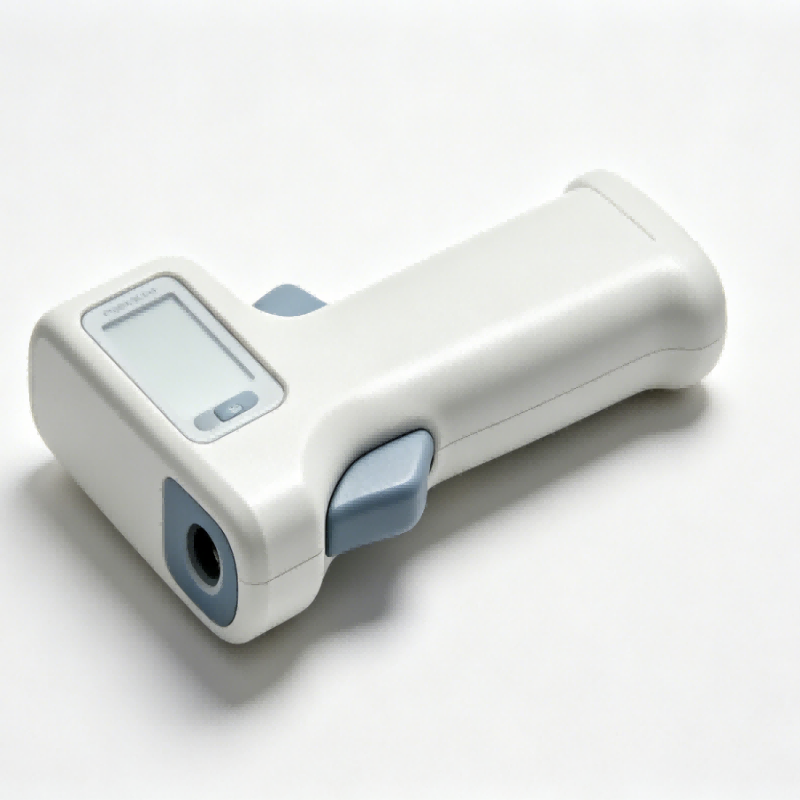
Device programmes often begin with a part like the Custom Non-Contact Infrared Forehead Thermometer, where a housing, a display window and a trigger are moulded as one assembly and the grade has to satisfy both the contact category and the cleaning method.
Key Takeaways
- Material choice follows sterilization: PSU and PPSU take steam at 134 °C repeatedly, PC and ABS are limited to ethylene oxide or gamma, and PEEK covers steam, gamma and chemical sterilisation.
- Cleanroom molding is classified by ISO 14644-1, with ISO Class 8 used for general device molding and ISO Class 7 for higher-risk components.
- Process validation is documented as IQ, OQ and PQ, and the performance qualification normally runs three consecutive production runs with all critical parameters monitored.
- Gamma sterilisation at a typical 25 kGy dose can yellow polycarbonate and embrittle polypropylene, so colour and impact testing is repeated after sterilisation.
- Biocompatibility is assessed to ISO 10993 by contact category and duration, and any change of resin, colourant or mould repair is treated as a change requiring re-validation.
What Are Medical Device Plastic Components Made From?
Medical device plastic components are moulded in a narrow set of engineering polymers chosen for sterilization tolerance and biocompatibility: PP, PE, PC, ABS, PSU and PPSU, PEEK, and cyclic olefin polymers for optical parts. Each grade must also carry a biocompatibility and material declaration package that the device manufacturer keeps in its technical file.
Selection runs in a fixed order. The sterilisation method is agreed first, because it eliminates more candidates than any other requirement. The contact category follows, based on whether the part touches intact skin, mucosa, blood or tissue, and for how long. Only then are mechanical properties compared, because a grade that cannot be sterilised is unusable no matter how strong it is.
| Material | Steam at 134 °C | Ethylene oxide | Gamma, 25 kGy | Typical device components |
|---|---|---|---|---|
| Polypropylene (PP) | Repeated cycles | Excellent | Moderate, becomes brittle over repeated doses | Syringe barrels, caps, trays |
| Polyethylene (PE) | Limited | Excellent | Good, crosslinks with dose | Connectors, tubing fittings |
| Polycarbonate (PC) | Not recommended | Good | Good, can yellow | Housings, luer fittings, blood handling parts |
| ABS | No | Good | Good | Non-critical enclosures, handles |
| PSU / PPSU | Repeated cycles, 1,000+ hours | Good | Good | Autoclavable trays, instrument handles, manifolds |
| PEEK | Repeated cycles, up to 250 °C | Good | Good | Implant-adjacent parts, surgical instruments, seals |
| COC / COP | Limited | Good | Good | Transparent bodies, microfluidic chips |
Is Polypropylene a Medical Grade Plastic?
Polypropylene is not inherently medical grade; a grade becomes suitable for medical use when it meets a defined set of requirements. In practice that means a resin supplied with an ISO 10993 or USP Class VI biocompatibility statement, a declaration of composition with no prohibited additives, and a processing route that avoids contamination. Standard industrial polypropylene is not interchangeable with those grades, even at the same melt flow index.
Which Materials Survive Which Sterilization Method?
Polysulfone and PEEK are the durable answers for repeated steam, while polycarbonate is the trap that catches first-time designers. Steam sterilisation places the part in saturated vapour at 121 °C to 134 °C, so the polymer must hold its shape above that temperature and resist hydrolysis. PSU and PPSU hold heat deflection temperatures near 174 °C and 180 °C and tolerate more than 1,000 hours of steam ageing; polycarbonate hydrolyses instead, losing impact strength and clarity from the first cycles. Where the part must also resist aggressive chemicals, PEEK extends the range beyond 250 °C at a material cost several times that of polysulfone. Gamma is the cheaper route for polymers that cannot take steam: a 25 kGy dose leaves PE, PSU and PEEK largely unaffected while yellowing PC and embrittling PP, and ethylene oxide at 40 °C to 60 °C is the gentlest option, which is why ABS is sterilised with it.
What Is Cleanroom Injection Molding?
Cleanroom injection molding is standard injection molding performed inside a controlled particle-count area, with the press, the material handling and the finished part all held inside the classified zone. The most common specification for device molding is ISO Class 8, with ISO Class 7 used where the part is invasive or fluid-path critical.
A cleanroom is a system rather than a room. Air is filtered to HEPA standard and supplied at positive pressure so that particles move outwards, temperature and humidity are held in a band that protects both the resin and the mould, and personnel enter through an airlock with gowning, gloves and hair covering. Resin is dried and conveyed inside the zone or transferred in sealed containers, because a dried engineering resin reabsorbs moisture the moment it is exposed to ordinary workshop air.
Three details decide whether the classification holds in practice. The mould must be cleaned between campaigns rather than wiped down, because vents and ejector clearances collect residue that releases as particles. Granulate feeding must be a closed loop, since conveying is the largest source of airborne contamination in a molding cell. And each batch must be recorded with its environmental data, because a cleanroom certificate is issued against measurement records, not against the equipment list.
How Do You Validate a Molded Medical Component?
A molded medical component is validated with installation, operational and performance qualification: IQ proves the press, mould, dryer and inspection equipment are installed as specified, OQ proves the process window delivers the part on demand, and PQ proves it does so across three consecutive production runs.
The process window is the deliverable of OQ. Rather than a single recipe, the molder defines the limits for melt temperature, mould temperature, injection speed, packing pressure and cooling time within which the part meets its drawing, and then demonstrates with a challenge that stepping to those limits still produces an acceptable part. That window is what makes production robust on a different shift, on a warmed-up tool, or with a new resin lot.
PQ then turns the window into records. Three consecutive runs, at normal production speed and with a defined sample plan, are inspected dimensionally and functionally, and the results are added to the device history record with the lot numbers of resin, colourant and any insert. After that, ISO 13485 discipline requires a documented change-control step for anything that could affect the part, including mould repair, machine substitution and supply-chain change. A useful companion is the DFM review checklist, which fixes wall thickness, draft and tolerance callouts while changes are still free.
How Does Sterilization Change Molded Part Dimensions?
Sterilization changes dimensions by relieving moulded-in stress and by driving off moisture, and the effect is largest in the first cycle. Steam at 121 °C to 134 °C can anneal a part so that it shrinks 0.1% to 0.3%, while gamma and ethylene oxide cycles at 40 °C to 60 °C usually move dimensions by less than 0.1%.
The practical consequence is that a medical part should be measured after sterilization, not only after molding, when the drawing carries tight tolerances. Where a dimension is critical, the tool is sized to sit mid-tolerance after the sterilization cycle rather than to hit nominal off the press. Polycarbonate is the classic case: a housing moulded to nominal can pass first article inspection and then drift outside tolerance after an ethylene oxide cycle, because the absorbed moisture and the residual stress both change at once.
Moulding parameters also affect what sterilization finds. A part packed at high pressure with a short cooling time carries more residual stress, so it distorts more when steam is applied. That is why cooling layout matters as much as material choice, as covered in our guide to mold design fundamentals.
What Documentation Does a Medical Molding Project Need?
A medical molding project needs a device history record built on traceability: resin and colourant lot numbers, the mould and machine used, the process parameters actually run, the inspection results, and the environmental records from the cleanroom. Biocompatibility evidence for the material and any additive is held alongside it.
Material documentation usually runs to three layers. The resin supplier provides a declaration of composition, a statement of no animal-derived content where required, and a biocompatibility statement to ISO 10993 or USP Class VI for the base grade. The molder adds the processing record and confirms that no prohibited additive, mould release or cleaning agent has entered the process. The device manufacturer then performs the final risk assessment against the part's contact category and duration of use.
Traceability has to survive the shop floor. A lot code on the box is not enough if the box contains parts from two cavities of two different shifts; the mould and cavity, the machine and the run window should all be recorded per batch. Choosing the right plastic material sets out the material properties that such a record has to pin down, and the step-by-step molding process guide explains the parameters that make each record meaningful.
What Does Cleanroom Molding Cost?
Cleanroom molding carries a premium of roughly 15% to 30% over ordinary molding on the piece price, driven by gowning, filtered air handling, closed-loop material feeding and slower changeovers. Tooling is quoted separately and normally lands between 20,000 and 100,000 USD for a multi-cavity medical tool.
| Cost element | Typical range | What moves it |
|---|---|---|
| Tooling | 20,000–100,000 USD once | Cavity count, steel grade, surface finish, hot runner |
| Piece price premium | 15–30% over standard molding | Cleanroom class, gowning, changeover frequency |
| Material | 2–90 USD per kg | Commodity PP at the low end, PEEK at the high end |
| Validation package | 8,000–30,000 USD once | Number of critical characteristics, sampling plan |
| Inspection | 5–12% of piece price | CMM programme, sample frequency, batch records |
Volume does not reduce validation cost; it only spreads it. A 20,000 USD validation package adds 4.00 USD per part at 5,000 units and 0.20 USD at 100,000 units, which is why programmes below a few thousand parts per year are usually built on a standard platform part and adapted, rather than validated from scratch.
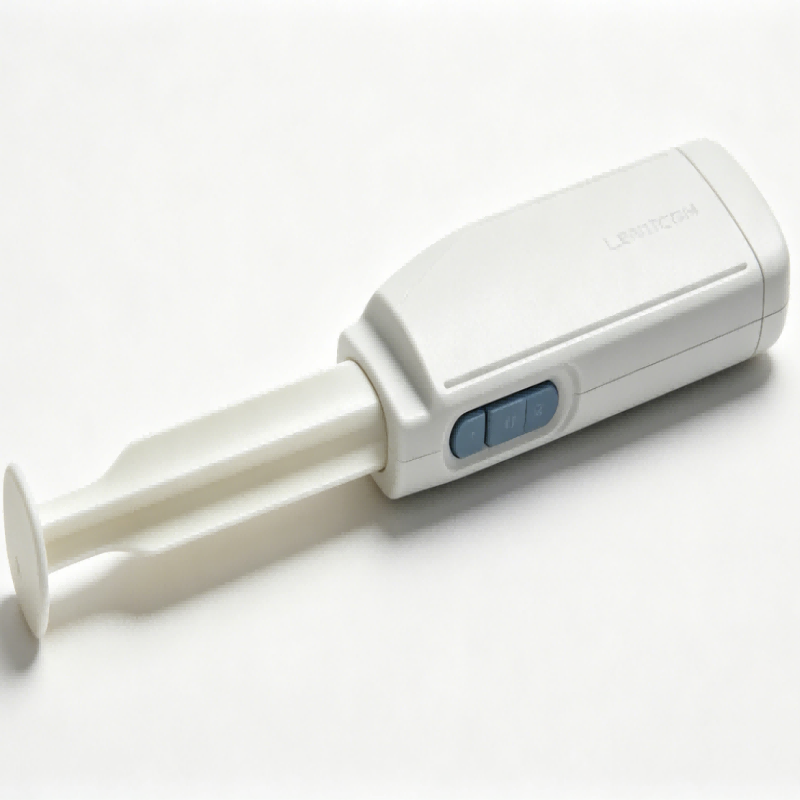
The same polymer families serve consumer-facing devices: the custom Cordless Handheld Wand Massager is moulded in a grade chosen for the surface a user touches and for the cleaning routine the product receives between uses.
FAQ
What is cleanroom injection molding?
Cleanroom injection molding means the press, material handling and finished parts stay inside an area with a controlled particle count, usually ISO Class 8 and ISO Class 7 for higher-risk components. Air is HEPA filtered and supplied under positive pressure, and operators enter through an airlock with gowning. The purpose is to keep particles and bioburden off the part as it is produced.
Do medical parts always need a cleanroom?
No. The cleanroom class follows the device's risk and the subsequent processing step. An invasive or fluid-path part is usually moulded in ISO Class 7 or 8, while a non-critical external housing that is cleaned or sterilised downstream can be moulded in a standard area with a controlled handling procedure. The device manufacturer's risk file sets the requirement.
Can polycarbonate be sterilized with steam?
It is not recommended. Polycarbonate hydrolyses when it is exposed to steam above about 120 °C, losing impact strength and clarity over repeated cycles, so it is normally limited to ethylene oxide or gamma. For parts that must survive repeated autoclaving, PSU, PPSU or PEEK are specified instead, at a higher material cost of roughly 20 to 90 USD per kg.
How long does medical molding validation take?
Plan for 8 to 16 weeks from design freeze to validated production. Tooling takes 4 to 8 weeks, then IQ and OQ take 1 to 3 weeks, and PQ adds 1 to 2 weeks plus inspection. Biocompatibility testing to ISO 10993, if it is required for a new material, adds a further 6 to 12 weeks and should run in parallel with tooling.
What cleanroom class is required for medical device molding?
The class comes from the device manufacturer's risk assessment. ISO Class 8 is the common starting point, and ISO Class 7 is specified for invasive, fluid-path or high-bioburden-risk parts, which is roughly a tenfold reduction in permitted airborne particles. Some non-critical housings are moulded in a controlled standard area with documented handling instead of a classified cleanroom.
What is ISO 10993 biocompatibility testing?
ISO 10993 is the standard series that assesses how a material behaves in contact with the body. Testing is selected by contact type and duration: a part touching intact skin for less than 24 hours needs far less than one contacting blood or tissue for more than 30 days. For a moulded component the base resin usually carries an existing statement, and only new colourants or additives need additional testing.
Conclusion
Medical device plastic components are decided by sterilization, cleanroom class and documentation before they are decided by strength. Choose a polymer that survives the sterilisation method, mould it in the class the risk file calls for, validate the process window with IQ, OQ and PQ, and measure the part after sterilisation rather than only after molding. That order is what keeps a validated part validated.
Send your drawing with the sterilization method, the cleanroom class and the annual volume. Xiamen Yistar Precision Manufacturing Co., Ltd will propose a material route and a validation plan, and mould Custom Engineering Plastic Components to the drawing and documentation your device file requires. For how other industries specify moulded parts, see our industry applications guide.
Contact Us
Xiamen Yistar Precision Manufacturing Co., Ltd
Address: Room 401, No. 37 Huliyuan, Tong'an District, Xiamen, Fujian, China
Phone / WhatsApp: +86-18064076912
Email: info@yistar-plastic.com
Open Hours: 24 Hours