



DFM Review: What to Prepare Before You Request a Quote

Best purchase I’ve made this winter! The color and knitting are exquisite and it’s so comfy! Went from NYC to Miami without ever taking it off. Super cute!!
Two identical part drawings can come back with tooling quotations that differ by a factor of two, and the reason is rarely the molder's margin. It is how much of the design was still open when the enquiry was sent. A DFM review closes those gaps before a price is issued, not after.
A DFM (design for manufacturability) review is the engineering pass that checks a 3D model and a 2D drawing against the limits of the injection molding process: wall sections, draft, undercuts, gate location, parting line, tolerance stack-up and material behaviour. Its output is not a report for the file. It is the list of changes that decide tooling cost, cycle time and how many trial iterations sit between T1 and an approved part.
This article sets out what to prepare before you request a quote and which design findings change the quotation.
At Yistar, the sequence runs in the opposite order to the one most buyers assume: NDA and drawing review first, quotation second, DFM and moldflow simulation third, tooling fourth — which is why the checklist below is requested before a price is issued.
Key Takeaways
- A DFM review audits part geometry against the molding process before a price is fixed, so tooling cost and lead time are estimated from manufacturable geometry rather than from untouched CAD.
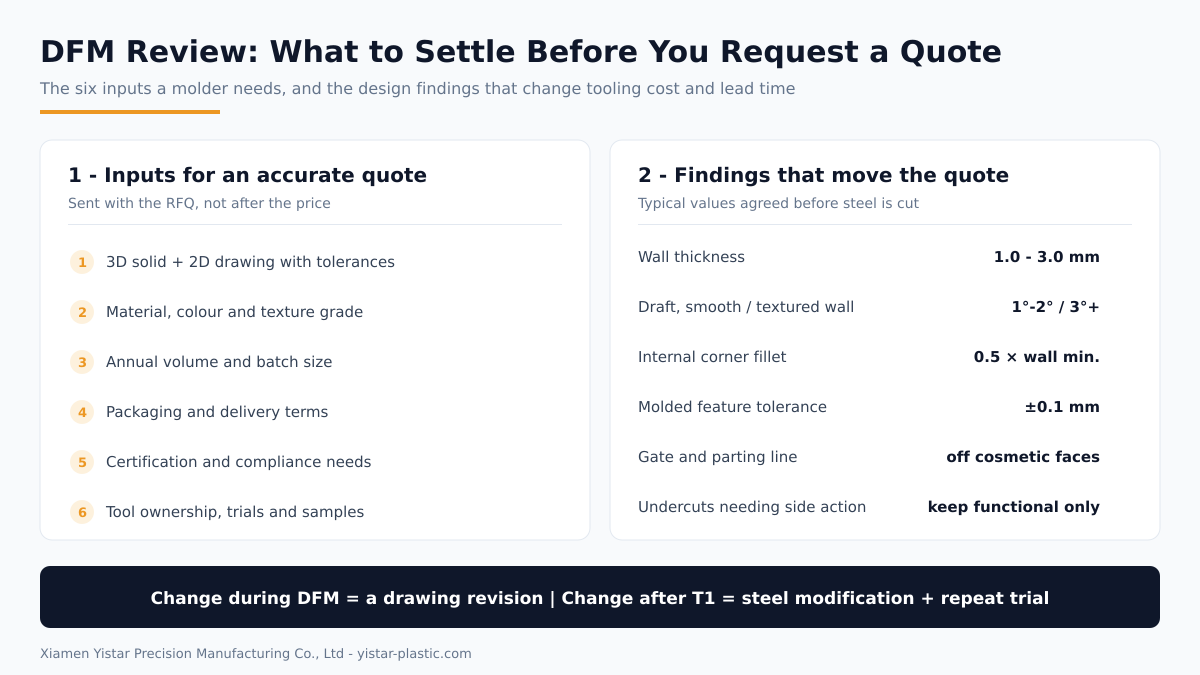
- Six inputs make a quotation accurate: a 3D model with a 2D drawing of critical dimensions and tolerances, material and cosmetic grade, annual volume and batch size, packaging and delivery terms, certification requirements, and tool ownership with trial expectations.
- Wall thickness is the most common DFM finding: most engineering resins mold well between 1.0 mm and 3.0 mm, and ribs should be held to roughly 0.5 to 0.6 of the nominal wall to avoid sink marks.
- Draft is a process requirement rather than a finish detail: 1° to 2° per side on smooth walls and 3° or more on textured surfaces, because every 0.025 mm of texture depth adds about 1° of required draft.
- A change made during DFM costs a drawing revision; the same change made after the tool is cut costs steel modification and a repeat trial run.
What Is a DFM Review and Why Does It Come Before a Quote?
A DFM review is an engineering audit of a part design against the injection molding process, carried out before a price is fixed. It checks wall thickness, draft, undercuts, gate and parting-line options, tolerance stack-up and material choice, then returns the changes that reduce tooling cost, cycle time and trial risk.
The timing matters more than the content. Tooling cost is set by cavity count, side action, surface finish and the steel the geometry forces; cycle time is set by wall thickness and cooling. Neither can be recovered later by negotiating the part price, because both are fixed the moment the tool is cut. A quotation issued from an unreviewed model is therefore either padded with contingency or revised upward.
A DFM deliverable is usually a marked-up model plus a short report: wall-thickness map, draft check, gate and runner proposal, a list of trouble features with the fix for each, and a tooling concept. Moldflow simulation is a separate step that predicts fill, weld lines, air traps and warpage — useful, but no substitute for the review that decides whether the geometry changes.
What Information Does a Molder Need to Quote a Plastic Part?
An accurate quotation needs six inputs: a 3D model with a 2D drawing showing critical dimensions and tolerances; the material and cosmetic grade; annual volume and batch size; packaging and delivery terms; certification requirements; and the tool ownership, trial and sampling terms attached to the project.
| Input | What the molder needs | What is missing if it is absent |
|---|---|---|
| 3D model and 2D drawing | STEP or native model, plus datum scheme, critical dimensions, tolerances and surface-finish callouts | Tooling is estimated from a nominal model and tolerance-driven cost is ignored |
| Material and appearance | Resin grade such as ABS, PC/ABS or PA66-GF30, colour target, texture grade and gloss level | Resin price is guessed and the shrinkage allowance in the tool may be wrong |
| Volume and batch size | Annual quantity, first order quantity and expected repeat orders | Cavitation cannot be fixed, so part price and tool cost cannot be optimised |
| Packaging and delivery | Inner packing, cartons, pallets and Incoterms such as FOB or DDP | Packing labour and freight are priced at a default rather than to your requirement |
| Certification and compliance | UL 94 rating, RoHS, REACH, food-contact or medical requirements, IP test expectations | Test cost and documentation are missing from the quotation and appear later as extras |
| Tool ownership and trials | Who owns the mold and cavities, trial sample quantity, FAI report and golden sample sign-off | Hand-over terms are undefined, which is the most expensive ambiguity in the project |
Every missing input is replaced by an assumption, and assumptions are where revised quotations come from: a molder that receives a complete package quotes a realistic process window, while a molder that receives a picture of a part quotes the fastest interpretation of it.
Which Design Issues Show Up in Most DFM Reviews?
The recurring issues are uneven wall thickness, insufficient draft, undercuts that force side action, sharp internal corners, abrupt thick-to-thin transitions at ribs and bosses, gate locations that conflict with cosmetic surfaces, a parting line that lands on a visible face, and tolerances beyond what the process can hold.
| DFM issue | Why it costs money | Change to make before quoting |
|---|---|---|
| Uneven wall thickness | Thick sections cool slower and sink; thin sections short-shot and the cycle is set by the thickest wall | Hold walls between 1.0 mm and 3.0 mm for most engineering resins and keep variation within about ±25% of the nominal wall |
| Insufficient draft | Parts drag, scuff or stick in the cavity, adding manual removal and reject rates | Allow 1° to 2° per side on smooth walls and 3° or more on textured faces; each 0.025 mm of texture depth adds roughly 1° of draft |
| Undercuts in the wrong place | Every undercut adds a slide, lifter or side action, which raises tool cost and maintenance | Keep a side action only for a functional feature and reposition cosmetic undercuts into the draw direction |
| Sharp internal corners | A sharp corner concentrates stress and becomes the crack starter under load or impact | Add a fillet of at least 0.5 times the wall thickness at every internal corner |
| Abrupt thick-to-thin transitions | Cooling imbalance warps the part and the tool needs extra tryout to find a stable window | Step the transition with a taper or ribbing instead of a straight change of section |
| Gate position against cosmetics | A visible gate leaves a witness mark that has to be hidden or finished as a second operation | Move the gate to a hidden or non-cosmetic face, or specify a texture that hides the mark |
| Parting line on a visible face | Flash and mismatch along a cosmetic parting line are difficult to polish out consistently | Move the parting line to an edge or shadow line and state the allowable flash on the drawing |
| Tolerance beyond process capability | An unrealistic tolerance forces 100% inspection or an endless trial loop | Tolerance molded features to about ±0.1 mm and reserve tighter values for machined or insert-molded features |
One or two rows usually dominate a project, and those are the ones to settle in writing before the tool is cut. The value of a DFM report comes from its ranking: a wall-thickness change is a drawing revision, while a gate-position change must be agreed before steel is ordered.
How Do Gate Location and Parting Line Change the Quote?
Gate location and parting line set the tool structure, so they change the quotation before any part price is calculated. The gate decides fill pattern, weld-line position and the finishing step needed to hide its mark; the parting line decides how the core and cavity split, how many side actions are needed and how flash is controlled on cosmetic surfaces.
The gate is also a volume decision. An edge gate keeps the tool simple but adds a degating step; a hot runner removes degating and balances multi-cavity fill at the cost of a manifold, heaters and a higher tool price that only pays back at high volume; a tunnel gate hides the gate mark automatically on high-volume parts.
The parting line is where cosmetic expectations meet tooling reality. Placing it on a visible face means every mismatch becomes a polishing operation or a rejected part; moving it to an edge, a radius or a shadow line makes the same tool cheaper to build and easier to run. Both decisions belong in the DFM discussion rather than a trial-and-error loop after T1, because moving a parting line afterwards means re-cutting the block, not editing a drawing.
What Should You Check Before Sending Drawings to a Molder?
Before sending drawings, confirm the model is a manufacturable solid rather than a surface model, that walls and draft are applied, that critical dimensions and tolerances are marked, and that the drawing states material, colour, texture, packing and tool ownership. The ten checks below cover the items that most often trigger a revised quotation.
- The 3D file opens as a solid body and every wall has a defined thickness.
- Draft is applied to all vertical faces, with more on textured surfaces.
- Undercuts are either eliminated or identified as features that justify a side action.
- Internal corners carry fillets and external corners carry radii.
- Ribs and bosses are thinner than the adjacent wall and have a fillet at the base.
- Gate and parting-line preferences are stated, or left explicitly open for a proposal.
- Critical dimensions are marked with tolerances; non-critical dimensions are left general.
- Material, colour, texture grade and gloss level are specified with a reference sample where possible.
- Annual volume, first order quantity and packaging requirements are written down.
- Certification, tool ownership, trial sample and golden sample terms are agreed in advance.
At Yistar, Custom Engineering Plastic Components and Custom consumer electronics projects are quoted from a DFM report rather than from a price list: the wall-thickness check, gate proposal and moldflow study arrive with the quotation, so a buyer compares designs instead of comparing prices.
The wider sequence around a DFM-led quotation — supplier selection, tooling approval and shipment — is covered in our guide on how to source custom injection molding from China.
How Does an Upfront DFM Pass Change Tooling Lead Time?
An upfront DFM pass moves engineering work ahead of steel cutting, so the mold is cut once rather than cut, trialled and modified. Corrections that would otherwise surface at the first trial — a stuck part, a short shot, a visible gate mark — become drawing revisions, which are measured in days rather than in another tool trial.
A mold program runs through design, machining, assembly, the first trial, dimensional inspection and sample approval, and for a typical mid-size mold those stages sit inside a lead time measured in weeks. A re-cut followed by a second trial adds a comparable block of time. The earlier a change is made, the cheaper it is: the same wall-thickness correction is a model edit before the tool is cut and a welding and re-machining job afterwards.
Trial runs, dimensional reports and sample approval are what convert a molded part into a production part, and the process itself — packing, cooling, cycle setting — is covered in our guide to the injection molding process. The geometry a DFM review checks is set out in our guide to mold design fundamentals, and the shrinkage and flow behaviour behind a wall-thickness decision is covered in our guide to choosing the right plastic injection molding material. Where a design needs a soft grip or a sealed joint, the extra rules are in our guide to overmolding and insert molding.
FAQ
What is a DFM review in injection molding?
A DFM review is a structured engineering check of a part design against the injection molding process before tooling is ordered. It examines wall thickness, draft, undercuts, gate and parting-line options, rib and boss geometry, tolerance stack-up and material behaviour, and returns a ranked list of design changes with the tooling and cycle-time effect of each one.
What should I prepare before requesting a molding quote?
Prepare a 3D solid model and a 2D drawing with critical dimensions and tolerances, the material and cosmetic grade, annual volume and first order quantity, packaging and delivery terms, certification requirements, and the tool ownership and trial sample expectations. With these six inputs a molder can quote the tool and the part without building contingency into either price.
How does DFM reduce tooling cost?
DFM reduces tooling cost by removing features that force complexity: side actions that could be repositioned into the draw direction, parting lines that could move off a cosmetic face, and tolerances that demand gauging rather than sampling. Each removal is cheaper before the steel is cut than after the first trial run.
Which design issues delay mold manufacturing?
The usual causes of delay are an insufficient draft that leaves parts sticking, uneven walls that short-shot or sink, a gate position that marks a cosmetic surface, and tolerances that the process cannot hold. Each one surfaces at the first trial and is resolved by a tool modification and a repeat trial rather than by a drawing revision.
Does a DFM review cost extra?
A DFM review normally costs nothing beyond engineering time, and most molders include it in the quotation stage because it protects their own program as much as the buyer's. A few days of review is inexpensive compared with a re-cut mold, a second trial run or a shipment that fails incoming inspection.
Conclusion
DFM is not a formality between drawing and purchase order. It is the step where tooling cost, cycle time and trial risk are set, and where a buyer still has the cheapest possible opportunity to change the geometry. Prepare the six inputs, work through the issue list, and settle the gate and parting-line questions before steel is ordered.
At Yistar, a Xiamen-based molder established in 1995, we work in that order: NDA and drawing review, then a DFM report with a wall-thickness and draft check, then a moldflow study and a quotation within 24 hours, and only then tooling.
Send Yistar your 3D model and 2D drawing: you receive an NDA-signed DFM report, a moldflow study and a quotation covering tooling and part cost, followed by FAI and CMM dimensional reports, golden sample sign-off, AQL shipment inspection and door-to-door freight when the program moves into production. Tell us the material and the annual volume you expect, and we will name the two or three design changes that matter most before the tool is cut.
Contact Us
Xiamen Yistar Precision Manufacturing Co., Ltd
Address: Room 401, No. 37 Huliyuan, Tong'an District, Xiamen, Fujian, China
Phone / WhatsApp: +86-18064076912
Email: info@yistar-plastic.com
Open Hours: 24 Hours